The short answer: best months to visit Kenya at a glance
The best months to visit Kenya for a first safari are January to February and June to October, when the two dry windows give the most reliable game viewing. July to October is the migration peak — the busiest and most expensive stretch of the year — so the right months for you depend on whether wildlife, coast, budget or space matters most.
Kenya’s rains are a pattern rather than a promise. The sources checked for this guide put the long rains in March to May and the short rains in November to December, and the Kenya Meteorological Department notes that rainfall varies sharply from year to year (Kenya Met).
Key takeaways
- January to February and June to October are the two dry windows most first safaris should aim for.
- July to October brings the migration, and doubles the Maasai Mara entry fee for non-resident adults from US$100 to US$200 per person per day.
- Long rains usually fall March to May and short rains in November and December; showers rarely last all day, but mud and road conditions are real trade-offs.
- Operator estimates checked November 2026: lodge rates in March to May can run 30–60% lower than peak, while July to October prices run 50–100% higher.
- The coast is generally warmer than the highlands; check local conditions for sea and wind.
Source: Seasonal Guide to Kenya | Ubuntu Travel, Checked November 2026
Quick verdict by trip type
- First safari: June or October — dry conditions, with June as the shoulder month and October inside the high season.
- Great Migration: July to October, with August and September the classic months for herd density.
- Coast: the coast is generally warmer than the highlands; check local conditions for sea and wind.
- Lower cost: March to May or November, if the camps you want are open and you can accept mud.
Kenya at a glance by month
The patterns below are the ones the sources describe. Read every entry as typical rather than fixed, and check county-level climate data for the exact place you are staying.
| Month | Rain | Safari | Coast | Crowds and price | Best for |
|---|---|---|---|---|---|
| January | Outside both rainy seasons | Dry-season predator viewing, fewer vehicles | General coastal warmth | Busy early, then shoulder | Value safari |
| February | Dry | Dry-season predator viewing, fewer vehicles | General coastal warmth | Shoulder | Dry-season safari |
| March | Long rains (March–May) | Rain can make tracks muddy | General coastal warmth | Low season; lower rates | Solo travellers, value |
| April | Long rains (March–May) | Wildlife disperses; birding is exceptional April–May | General coastal warmth | Low season; lower rates | Birding |
| May | Long rains (March–May) | Rain possible; check road plan | General coastal warmth | About half of July’s rate | Budget safari |
| June | Dry season begins | Strong viewing with fewer vehicles than July | General coastal warmth | Shoulder; Mara fee still US$100 | Best-value dry month |
| July | Dry | Migration high season | General coastal warmth | Peak; Mara fee US$200 | Migration |
| August | Dry | Peak wildlife density and vehicle numbers | General coastal warmth | Peak; busiest and most expensive | Migration density |
| September | Dry | Classic Mara wildlife density | General coastal warmth | Peak | Migration, book early |
| October | Dry | Herds start moving south | General coastal warmth | Fee stays high to 31 December | Migration tail |
| November | Short rains (November–December) | Green season, fewer vehicles | General coastal warmth | Shoulder; rates soften | Value |
| December | Short rains (November–December); busy from late December | Good | General coastal warmth | Shoulder early; busy late December | Festive trip |
How Kenya’s seasons actually work
Long rains vs short rains
The long rains fall in March, April and May and rarely last all day, while the short rains fall in November and December as light, unpredictable showers (Seasonal Guide to Kenya). Kenya Met publishes county-level climate information through its Maprooms portal, which is more useful than a national forecast when you are choosing between Narok and Kwale (Kenya Met).
Why the coast does not match the Mara
Altitude drives temperature here more than latitude. Daytime temperatures typically sit around 68–85°F, warmer on the coast, and altitude largely determines how cool a place feels (Ubuntu Travel). That is why Nairobi and the highlands feel cooler than the coast, and why Mara mornings can be cold on an open vehicle (Masai Mara planning guide).
What green season really means
Green season is the trade: fewer vehicles, greener landscapes and lower rates, in exchange for rain and mud. The Mara’s green season is usually given as April to June and November to mid-December, when rates drop significantly and road conditions have to be planned around; April to May is described as exceptional for birding (Masai Mara planning guide). Operator estimates checked November 2026 put lodge prices in March to May 30–60% below peak (Masai Mara entry fees).
Check the camp, not just the forecast
The Mara’s black cotton soil turns hard going in the rain, which is why a 4×4 rather than a minivan matters in wet months (Masai Mara safari cost). Confirm the specific camp is open and ask what the road plan is before you book a green-season date.
Month-by-month guide to Kenya
January
January sits outside both rainy seasons and is a strong-value dry month. January to March is described as dry-season predator viewing with fewer vehicles and more accessible rates than the migration months (Beyond the Plains Safaris).
February
February continues the January–March dry-season pattern, with strong predator viewing, fewer vehicles and lower rates than peak. Mara fees stay in the lower band until 30 June.
March
March sits inside the March to May long rains, so plan for possible mud. March is also named among the months when some Mara camps waive the single supplement, which suits solo travellers willing to accept mud.
April
April sits inside the long rains, with lush scenery, exceptional birding from April to May and rates below peak. Wildlife disperses and rain can make tracks muddy, so confirm your camp’s road plan before you commit.
May
May is still long-rains season. May and June are described as half-price against July, with good grass cover and thinner crowds (Valley Safaris).
June
The dry season begins, and June is the value month inside it: fewer vehicles than July, with early migration arrivals possible. The Mara fee stays at US$100 per adult per day until 30 June.
July
The fee jumps to US$200 per non-resident adult per day on 1 July and the migration high season begins. Peak camps fill six to twelve months ahead, so this is a month to book early rather than late.
August
River crossings are never guaranteed, and the US$200 fee applies all month.
September
September still suits travellers prioritising classic Mara wildlife density, and the reserve stays busy. If you want the migration with more breathing room, a conservancy outside the reserve can mean fewer vehicles.
October
October is the tail: herds begin moving south from October to December, and the fee band stays high to 31 December even after the wildlife starts to move. Early October gives you the best of both.
November
Short rains bring light, unpredictable showers, green landscapes and far fewer vehicles. Rates soften and roads can be muddy, so confirm your camp’s road plan before booking.
December
The short rains fall in November and December, and a second busy period starts in late December, with high fees and holiday demand. Crime rates are often higher around Christmas and New Year, which is worth factoring into a festive trip (FCDO).
The Great Migration in the Maasai Mara: timing, odds and smarter bookings
When the herds usually arrive
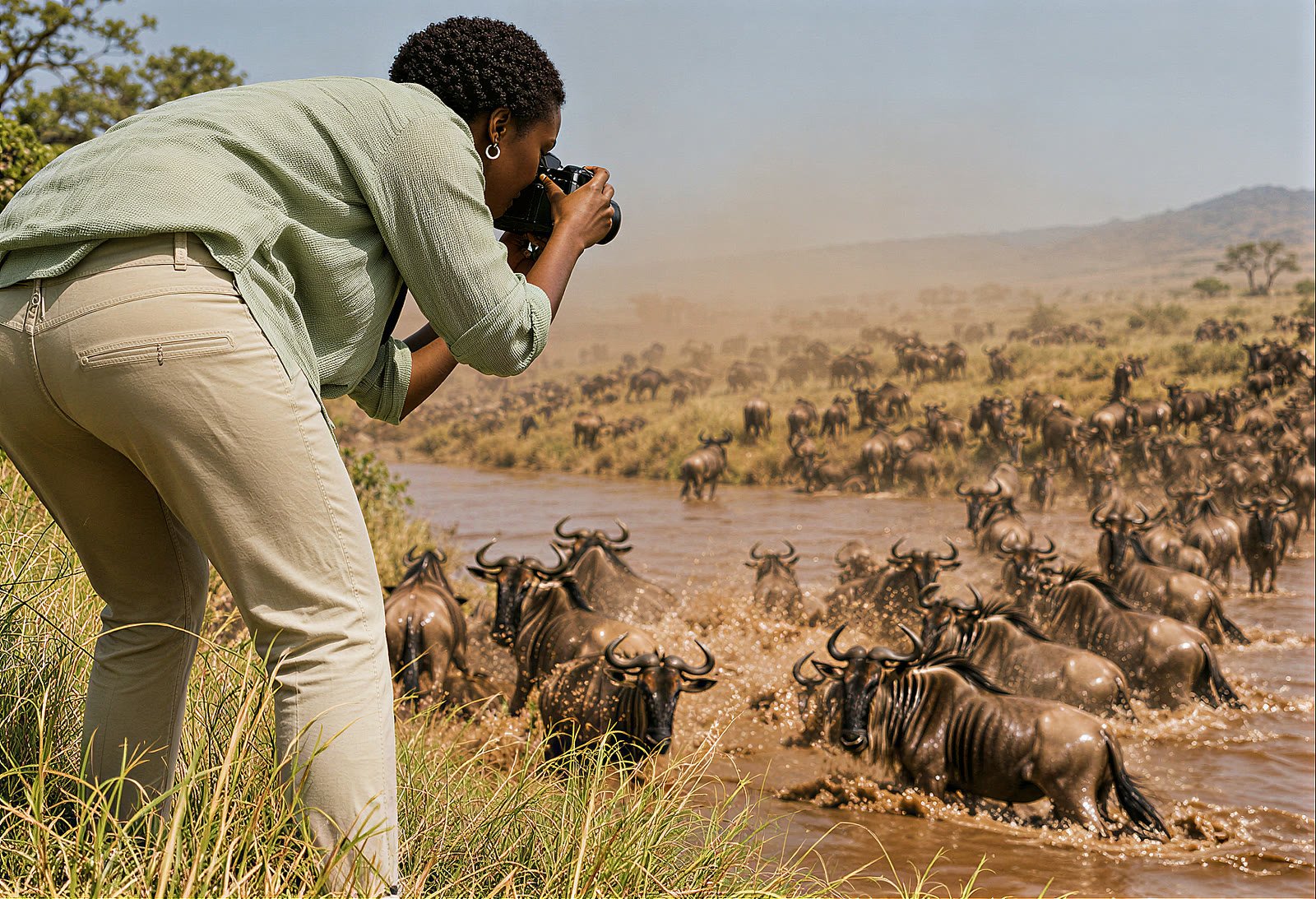
The herds usually move into the Maasai Mara from July to October, crossing the Mara River in that window (Valley Safaris). From April to June they are moving north through the Grumeti, so they are not in Kenya at all (Ubuntu Travel).
Why river crossings are not guaranteed
Herds cross the river repeatedly rather than once, and no operator can schedule it. The crossing window is generally July to October, and August is the busiest for vehicles, so set expectations before paying a peak-season premium.
Should you book a conservancy?
A conservancy stay gives you off-road driving, night drives and walking safaris, which the main reserve does not allow, plus far fewer vehicles. Conservancy fees currently sit at US$130 per person per night plus a US$5 habitat payment, rising to US$150 for most conservancies next season, and guests who never enter the reserve do not pay the county entry fee. A peak-August day trip into the reserve adds US$200 per adult.
Coast or safari: Diani, Watamu and Lamu logistics and when to slot the beach in

Diani and the south coast
Diani can be part of a safari-and-beach trip. Month-by-month wind, seaweed and sea conditions are not settled in the sources checked here, so ask the hotel about your exact dates and pull Kenya Met’s county data.
Watamu, Lamu and the north coast
For Watamu, plan the domestic connection in advance. Lamu is fly-in only: the FCDO says Lamu Island and Manda Island should be reached by air into Lamu airport on Manda Island, the only commercial air option, and both islands are the parts of Lamu County excluded from the no-travel zone.
Combining safari and coast
Use Nairobi as the hub, keep a buffer day for domestic connections, and do not cut the transfer fine at either end.
Crowds, costs and seasons: when Kenya is busiest
Peak vs shoulder vs green season
Peak is July to October for the migration, with a secondary busy period from late December into early January; shoulder months are January to February, June and November to early December. March to May is the low-season stretch, and the Mara’s green season is given as April to June and November to mid-December.
| Season | Months | Effect on price | Trade-off |
|---|---|---|---|
| Peak | July–October; late December–early January | Operator estimate checked November 2026: lodges 50–100% higher July–October; Mara fee US$200 July–December | Crowds and the 12-hour ticket clock |
| Shoulder | January–February, June, November–early December | Lower rates than peak | Fewer vehicles than peak |
| Green/low | March–May | Operator estimate checked November 2026: lodge rates 30–60% lower March–May | Mud, road conditions, dispersing wildlife |
Entry fees are the cost most readers underestimate, and they are seasonal.
| Park or reserve | Non-resident adult, per person per day |
|---|---|
| Maasai Mara, July–December (Narok County schedule) | US$200 |
| Maasai Mara, January–June (Narok County schedule) | US$100 |
| Amboseli or Lake Nakuru | US$90 |
| Nairobi National Park | US$80 |
| Tsavo East or Tsavo West | US$80 |
| Mount Kenya | US$70 |
| Hell’s Gate or Longonot | US$50 |
KWS rates from KWS; Maasai Mara rates from the Narok County schedule.
So yes, Kenya is expensive at peak: operator price bands published in November 2026 put a budget camp outside the reserve at US$80–150 per person per night, a mid-range lodge or tented camp at US$200–450, and a luxury or conservancy property at US$600–1,500+ (Masai Mara safari cost). A return bush flight to the Mara is typically US$280–450 per person.
Source: KWS and Narok County schedules, Checked November 2026
How far ahead to book
Peak-season Mara camps fill six to twelve months ahead, and three to six months is the other common advice for high season.
Best month by trip type
| Trip type | Best months | Why | Trade-off |
|---|---|---|---|
| First safari | June or October | Dry weather; June has fewer vehicles than the July–August peak | Fee band is high from July |
| Great Migration | July–October | Classic herd density in the Mara | Highest prices and vehicle numbers |
| Lower-cost trip | March–May or November | Operator estimate: March–May rates 30–60% lower; November rates soften | Mud, road conditions and rain |
| Family trip | Dry months, book early | Dry-season conditions; fewer vehicles outside peak | Sightings are probabilities, not guarantees |
| Birding | April–May | April to May is described as exceptional for birding | Rain and muddy tracks |
Practical planning: what to check before you book
Entry and health checks
It is valid for travel within 90 days of issue, standard processing takes three working days (sometimes longer), the fee is US$30 and expedited processing adds US$100, and each passenger needs their own approval. Ghanaian passport holders are on the exemption list for stays up to 90 days; US and UK travellers are not, and the length of stay is decided by the officer at entry.
Malaria follows the map more than the calendar: transmission covers all areas below 2,500 m including game parks, with rare cases in central Nairobi, and the CDC recommends prescription prevention for parts of Kenya but only bite avoidance for central Nairobi (CDC). Yellow fever vaccine is generally not recommended for travel limited to Nairobi or the coast counties (Kilifi, Kwale, Lamu, Mombasa, Tana River) except Taita-Taveta, and dengue is present year-round. Meningococcal vaccine is recommended for the meningitis belt in the dry season, roughly December to June. Book a pre-travel appointment about a month before departure.
Fees, gates and transfers
The Mara reserve is open 06:00 to 18:00, and road transfers from Nairobi take 5–6 hours against about 54 minutes from Wilson Airport. Arrive at 06:00 to get the full ticket value; an afternoon arrival burns a whole day’s fee for two hours. Nairobi National Park is a sensible buffer-day option — US$80, open 06:00 to 18:00, 117 km², 8–10 km from the CBD — though elephants are not resident there (Nairobi National Park).
The 12-hour rule, plainly
A Maasai Mara ticket covers 12 hours, not 24, under the Narok County schedule, and the clock starts when your vehicle passes an official gate. Leaving by road after 10:00 on your departure day triggers another full day’s fee, while early-morning flight departures are exempt, so checkout logistics can cost more than a game drive. Gates are increasingly cashless, with the Mara Triangle accepting only card or mobile money.
Safety, calmly
The FCDO maintains warnings against all travel to parts of Kenya and against all but essential travel to others, including Moyale Town and 5 km around it, and travelling against that advice can invalidate your insurance (FCDO). The terrorism threat is described as a standing one that applies in every month, beaches and safari parks appear among the settings named as potential targets, and crime rates are often higher around Christmas and New Year. Use reputable operators rather than touts, arrive in camp in daylight, avoid driving at night and keep the Kenya Tourism Federation’s safety centre details to hand.
What this means for you
If your dates are flexible, June gives you dry-season wildlife with lower rates than July–October; if the migration is the point, book July to October early and budget for the US$200 daily fee. If the coast is part of the plan, choose the order around domestic flights.
Next step: see how this site researches and updates travel guides for the sourcing standard behind these dates, read for the approach to planning, or contact us if you want help applying these seasons to a Kenya itinerary.
Sources
- Kenya Meteorological Department: State of the Climate Kenya Report
- Kenya Meteorological Department: Climate Data Management
- Seasonal Guide to Kenya, Ubuntu Travel
- Planning a Masai Mara Safari, Masai Mara National Reserve
- Masai Mara Safari Packages 2026/2027, Beyond the Plains Safaris
- Masai Mara Entry Fees: 2026 Guide for Self-Drivers, Safari Masters
- Masai Mara Conservation Fee Increase 2026 Explained, Valley Safaris
- Masai Mara Park Fees: $100 to $200 Per Day Explained, Valley Safaris
- Masai Mara Safari Cost: Fees, Packages and the Extra Charges
- Nairobi National Park, Kenya
- Kenya eTA official government website: FAQs
- Kenya eTA official government website: How to apply
- CDC: Kenya travel health information
- UK FCDO: Kenya travel advice
- UK FCDO: Kenya safety and security
Frequently asked questions
What are the best months to visit Kenya for a safari?
January to February and June to October are the two dry windows, with June the shoulder month with fewer vehicles and October still inside the high season.
When is the Great Migration in the Maasai Mara, and is it guaranteed?
The herds usually move into the Maasai Mara from July to October. Crossings are wildlife behaviour, so no operator can guarantee one on a given day.
What is the difference between Kenya’s long rains and short rains?
The long rains fall in March, April and May and rarely last all day, while the short rains fall in November and December as light, unpredictable showers.
When is the cheapest time to visit Kenya?
March to May is a lower-cost stretch: operator estimates checked November 2026 put lodge rates 30–60% below peak, and the Mara entry fee is US$100 rather than US$200. November also brings lower rates and fewer vehicles, if your camp is open.
What is the 12-hour rule for the Masai Mara?
A Mara entry ticket covers 12 hours rather than 24, starting when your vehicle passes an official gate. Leaving by road after 10:00 on departure day triggers another full day’s fee, though early-morning flight departures are exempt.