An e-visa Ghana application is made online at evisa.immigration.gov.gh, costs US$260 with standard processing (US$338 priority, US$442 express, checked 15 November 2026) and is normally decided within 5 to 96 hours, depending on the tier you buy. The form takes about 25 minutes once your documents are ready: check eligibility, create an account, fill the form, upload the photo and supporting files, pay, then track and download the approval. The passport scan, photograph and accommodation proof are worth getting right, because the portal does not let you edit or withdraw an application after you submit.
This matters more in 2026 than it did last year. Ghana overhauled its visa system on 25 May 2026, replacing routine visa on arrival with digital pre-travel authorisation: an eVisa for visa-required nationals and a free ETA for African passport holders, as Fragomen’s summary of the reforms sets out. If you are reading a page that tells you to pay US$200 at the airport, note that a visa on arrival now requires prior approval, per GIS.
Key takeaways
- Apply only at the official portal, evisa.immigration.gov.gh, and run the eligibility checker before anything else.
- Fees are flat by processing speed, not nationality: US$260 standard, US$338 priority, US$442 express as of 15 November 2026. They are non-refundable except for system errors or duplicate payments.
- Your passport needs six months’ validity beyond departure and three blank pages; the photo must be roughly 3.5 cm × 4.5 cm on a plain light background with no filters.
- The eVisa is single-entry, valid for 90 days from issue, and the officer at the border sets your stay, up to 60 days.
- After submission you cannot edit or withdraw. If immigration requests more information, you have three days to answer.
Source: Ghana eVisa — Applicant Guide, November 2026
What the Ghana e-visa is — and what it is not
The Ghana e-visa is an electronic authorisation issued by the Ghana Immigration Service with the Ministry of Foreign Affairs, applied for and paid for online before you travel. It is not a visa on arrival, and it is not a guarantee of entry: the portal’s terms of use state that immigration officers at the port of entry make the final decision.
Ghana now runs several routes side by side, and picking the wrong one wastes money.
| Route | Who it is for | Cost | Where you get it |
|---|---|---|---|
| eVisa (B1 business, B2 tourist) | Visa-required nationals visiting for tourism or business | US$260 standard, US$338 priority, US$442 express (checked 15 November 2026) | evisa.immigration.gov.gh |
| Free ETA | African passport holders and some visa-waiver nationals | Free | Same portal, through the eligibility checker |
| Visa-free entry | ECOWAS and AES nationals | None | No application; valid passport on arrival |
| Visa on arrival (pre-approved) | Exceptional cases, arranged by a Ghana-based host before travel | US$200 single entry, 30 days (GIS guide, 2025) | GIS headquarters or Accra International Airport, via the host |
| Embassy visa | Applicants who cannot or prefer not to use the online route | Not stated | Ghana’s diplomatic missions |
Two things about that table are easy to get wrong. The free ETA is not entry without formality: ECOWAS, African Union and Caribbean nationals qualify for a free Electronic Travel Authorisation under the portal wording quoted by VisasNews, and it still has to be applied for and approved before travel unless an existing exemption applies. And visa on arrival is now an exception rather than a plan: it requires prior approval, arranged by a Ghana-based host before travel.
Who can use the Ghana e-visa?
The portal homepage says it accepts applicants from more than 190 countries. Do not guess from your passport colour: the applicant guide directs everyone to the eligibility checker, because the visa-free, ETA and eVisa routes depend on nationality, passport type and current policy.
Broadly, ECOWAS and AES nationals enter visa-free; most other African passport holders get the free ETA; US, UK, EU and most other nationals pay for the eVisa, according to FIRMUS Advisory’s 2026 guide. ECOWAS states listed by GIS include Nigeria, Senegal, Gambia, Guinea, Guinea Bissau, Sierra Leone, Burkina Faso, Togo, Ivory Coast, Mali, Niger, Liberia, Benin and Cape Verde (GIS visas page).
Two official pages disagree, and you should know it. GIS’s visa regime table lists African Union member states as requiring a visa granted on arrival or at a mission for 60 days, while the eVisa applicant guide says all African passport holders automatically receive an ETA. Use the checker on the portal to see which route applies. If it offers you an ETA, take the ETA.
Dual nationals holding a Ghana dual nationality card or right of abode do not need a visa, per the same FIRMUS guide. If you carry a foreign passport without that card, run the checker before you pay for anything. Some third-party checklists still route US applicants to a consulate; the consular route is expected to remain, but a tourist or business trip is handled online.
The only official Ghana e-visa portal (and how to spot lookalikes)
The official application site is evisa.immigration.gov.gh, presented as a Ghana Immigration Service platform run with the Ministry of Foreign Affairs, and it has been the channel since the May 2026 launch. Use evisa.immigration.gov.gh rather than typing an address you saw in an advert.
One URL warning is worth taking seriously. The official portal is evisa.immigration.gov.gh, while GIS pages are on gis.gov.gh. Treat any other address as unverified.
What the official portal looks like
The real portal carries government branding and the GIS name, and offers a specific set of services: an eligibility checker, account creation, the application form, document upload, payment through providers presented on the site, a Track Application page and a Visa Verification page that airlines and others can use. The fee screen shows the tier prices before you pay.
Red flags on paid ‘assistance’ sites
- A service fee bundled into the "visa cost". Private assistance exists and is separate from the government fee; Africa Tour Visa says as much itself, noting that eligibility, fees and approvals are controlled by the Ghanaian authorities.
- Check whether the site offers a tracking page, a verification page and a named government body.
- Be wary of requests to send passport scans by WhatsApp or email, or to open an account in your name. The portal’s terms forbid opening an account on someone else’s behalf without authorisation.
- A guaranteed approval. Approval is not even a guarantee of entry.
Check the fee on the portal, not on a blog
Third-party sites charge mark-ups on the same application. The portal fee screen is the final word on what you owe; if a site’s total is higher, you are paying for assistance you did not ask for.
Documents and photo rules that get your application approved

The passport scan, the photo and the accommodation proof are three files to get right. Get those right and the rest is typing.
- Passport valid 6 months beyond departure, with 3 blank pages Check
- Colour photo, about 3.5 × 4.5 cm, under 6 months old Check
- Return or onward ticket Check
- Accommodation covering every night of the stay Check
- Yellow fever certificate showing vaccination at least 10 days before arrival Check
- Business invitation letter plus signatory ID (B1 only) Check
Passport and personal documents
Your passport must be valid for at least six months from your intended date of departure from Ghana and have at least three blank pages, per the applicant guide. Upload a clear colour scan of the bio-data page.
Only genuine, unaltered documents are allowed under the terms of use, and false information can lead to denial. Type your name exactly as the passport prints it, in the same order, middle names included.
Photo specifications
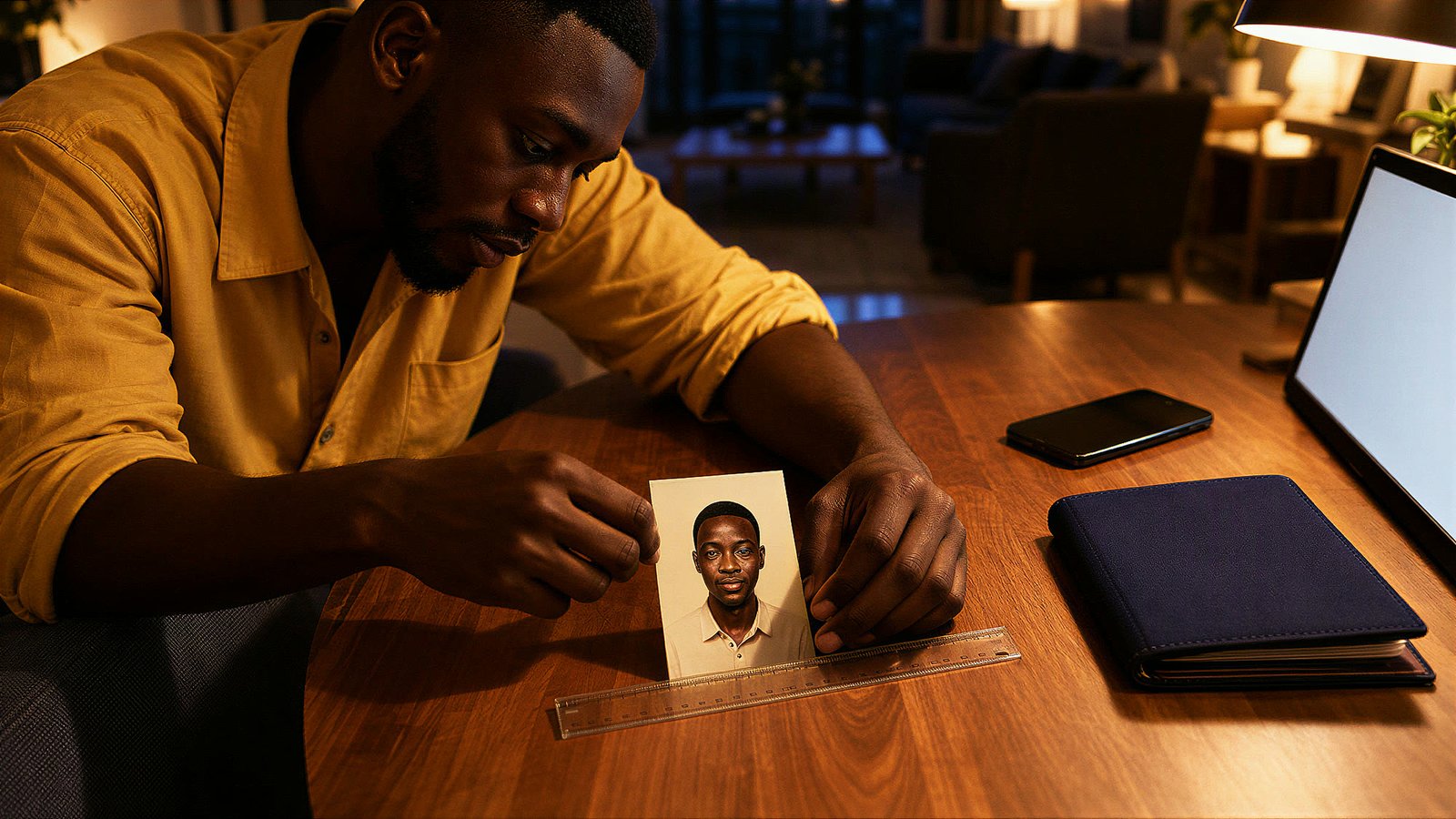
The guide asks for a recent colour photograph, approximately 3.5 cm × 4.5 cm, no more than six months old, on a plain light or white background, with the full face visible, eyes open and mouth closed. No sunglasses or face-obscuring items except permitted religious or medical coverings, no exaggerated expression, and no filters or digital alteration that changes the image.
Confirm the exact pixel dimensions, file-size limit and accepted file formats on the portal before uploading. Do not copy the UK’s visa photo rules (at least 600 × 750 pixels, 50KB to 6MB, jpg or jpeg); those are UK Visas and Immigration’s specification, not Ghana’s.
In practice: stand against a plain wall in daylight, no flash, have someone else take the shot from about chest height, then crop to the 3.5 × 4.5 cm proportions and save at the highest quality the upload accepts.
Supporting documents
The paid categories are B1 business and B2 tourist, and the document sets differ.
| Document | B2 tourist | B1 business |
|---|---|---|
| Passport bio-data page | Yes | Yes |
| Passport-style photo | Yes | Yes |
| Return or onward itinerary | Yes | Yes |
| Accommodation proof for the full stay | Yes | Yes |
| Bank or card statements, last 3 months | Yes | Proof of financial means |
| Host ID (Ghana Card or bio-data page) where staying with a host | Yes | Where applicable |
| Signed invitation letter stating purpose, plus signatory ID | Not specified | Yes |
| Company registration documents | Not specified | Yes |
| Company tax clearance certificate | Not specified | Yes |
| Yellow fever certificate | Required for entry | Required for entry |
Three details trip people up. Accommodation must cover every night: a three-night booking for a 12-night trip, which is the median stay for inbound visitors in the Ghana International Travellers’ Survey, is a rejection risk. Every signed letter needs the signatory’s identification, usually a Ghana Card or passport bio-data page. And transit applications exist, so confirm the document list on the portal.
Yellow fever is separate from the visa. A valid certificate is required for entry from travellers aged nine months and older, per Ghana Citizenship and GuideX, and travellers to outbreak regions should be vaccinated at least 10 days before travel, per the CDC’s Ghana page. Port Health checks it at the airport before you reach immigration. Sources conflict on validity: Ghana Citizenship says certificates are valid for life, while a consular checklist requires them to be not more than 10 years old.
Minors: the portal’s terms say applicants must be 18 or have parental or guardian consent, and consular checklists for under-18s mention a parental consent letter. Confirm the current documents with the portal before applying for a child.
Ghana e-visa fees, payment and processing times
How much the e-visa costs
The fee is a flat rate, not based on nationality, and it depends on the processing speed you choose. As checked on 15 November 2026 on the portal’s visa information page:
| Processing tier | Fee per application | Stated processing time |
|---|---|---|
| Standard | US$260 | up to 96 hours |
| Priority | US$338 | 48 hours |
| Express | US$442 | 5 hours |
Source: Ghana eVisa — Applicant Guide, November 2026
Multiple entry: check before you pay
The applicant guide states that Ghana currently issues single-entry eVisas only. Some 2026 sources list multiple-entry prices (US$468 standard, US$608 priority, US$796 express, per FIRMUS Advisory and VisasNews). If a multiple-entry option appears on your application, confirm the amount and entry terms on the fee screen.
Payment problems
Payment runs through providers presented on the official portal; the guide does not name card networks or wallets. Expect your bank to be cautious: card payments to government portals are often flagged as fraud, which is why FIRMUS advises notifying your bank before paying.
If money leaves your account but the application still shows unpaid, do not pay again. Keep the receipt or bank notification and contact support. The guide caps you at three payment attempts; after three failures, wait 24 to 48 hours before trying again.
Fees are generally non-refundable, with exceptions for system errors and duplicate payments, per the terms of use. Applicants bear their own bank or transaction charges, nothing is processed until the full fee is paid, and a receipt goes to your registered email.
How long it takes
Source: Ghana eVisa — Applicant Guide, November 2026
The applicant guide quotes 5 hours for Express, 48 for Priority and 96 for Standard. VisasNews quoted 72 hours for the standard tier at launch, and Fragomen gives 72 to 96 hours as typical. Treat all of them as estimates: the terms of use say processing times are not guaranteed, and a request for information pauses processing until you reply.
When to apply
Apply so that your travel falls inside the 90-day validity window, and no earlier. The guide warns against applying well in advance of a trip.
A workable target is two to three weeks before departure, longer for December. Commercial services suggest at least a week and ideally 30 days (VisaHQ). Keep flights refundable until the approval email lands.
Step-by-step: applying on the official Ghana e-visa portal
- Run the eligibility checker on evisa.immigration.gov.gh with your nationality and passport type.
- Create an account with an email you can open while travelling.
- Start a new application and pick the correct category: B2 tourist or B1 business.
- Fill personal, passport, travel and contact details exactly as the passport prints them.
- Upload the photo, bio-data page, itinerary, accommodation proof and any route-specific letters.
- Review every field, pay on the portal, and save the reference number before closing the page.
- Track the application and download the approval when it arrives by email.
Name-order and passport-number errors are among the common mistakes listed by Africa Tour Visa; check the address of your first night in Ghana too. If you are staying with family, you still need that address and the host’s ID.
Tracking needs your reference number plus the verification code emailed to you; do not rely on the approval email alone. Keep the PDF on your phone and print one copy. Before flying, check the name and passport number on the eVisa against the passport. A corrected eVisa is reissued rather than amended, and you travel on the new copy.
When the site rejects your application or photo: fixes that work

Start with the rule that shapes everything: applications cannot be edited or withdrawn once submitted. If you spot a mistake afterwards, contact support rather than submitting a second application and paying again.
Photo rejected
Recrop to the 3.5 × 4.5 cm proportions and shoot again against a plain wall rather than editing the background. Remove glasses, close your mouth, open your eyes and save without filters. Then confirm the accepted file type and size limit on the portal before uploading.
Payment failed
Tell your bank the payment is expected, and try another provider shown on the portal. Do not exceed three attempts. If you have been debited, stop and contact support with the receipt attached; that is one of the two cases the terms recognise for a refund.
Application stuck or rejected
Check the Track Application page before assuming a problem, and check your spam folder. A request for information gives you three days to respond and pauses processing until you do.
A denial comes with a reason by email and can be appealed once. The explanation must run to at least 50 characters, and you can attach up to three files of 10 MB each. A successful appeal does not approve you: it returns the application to review.
A second application is not a fix
Fees are non-refundable on refusal. Read the rejection reason, correct that specific document, and use the appeal or the official support channel rather than paying twice.
After approval: arrival checks and common mistakes
At the airport
Print the eVisa and keep the PDF on your phone. Carry the original yellow fever certificate where you can reach it without opening a checked bag, since Port Health checks it before immigration at Accra International Airport, still widely listed as Kotoka International Airport.
Expect to show your return or onward ticket, accommodation details and evidence of funds. Airlines check documents against IATA Timatic at check-in, and officers may ask about the purpose of your visit. Declare cash over US$10,000.
Your permitted stay is set by the entry stamp, not by the visa: up to 60 days, decided by the officer.
Mistakes to avoid
- Applying outside the 90-day validity window, or too late for December.
- A passport number or name order that does not match the passport, discovered after submission.
- Accommodation that covers only part of the trip.
- Forgetting yellow fever, or planning to vaccinate at the airport. Port Health in Terminal 3 vaccinates for US$20, but a certificate is not valid until 10 days after a primary dose.
- Confusing a fee exemption with visa-free entry: a free ETA is still an authorisation you must obtain.
- Overstaying. Check the GIS fee schedule effective 15 May 2025 for extension fees. Extension applications are lodged with your passport and two passport-size photographs.
From e-visa to arrival: planning the rest of your trip
Once the approval is in your inbox, the planning shifts to timing and the first few days.
Car hire and a short let in Accra
Arriving at Accra International Airport with luggage and no plan for the drive into the city is avoidable: car hire with a driver and short-let apartments can be arranged before you fly.
Disclosure: this guide includes a booking link.
Your next step: open evisa.immigration.gov.gh, run the eligibility checker with your nationality and passport type, and write down which documents you are still missing before you start the form.
Sources
- Ghana eVisa — Official Electronic Visa Application Portal
- Ghana eVisa — Applicant Guide
- Ghana eVisa — Visa information and fees
- Ghana eVisa — Terms of Use
- Ghana Immigration Service — Visas
- Ghana Immigration Service — How to Acquire a Visa on Arrival to Ghana
- Ghana Immigration Service — Fees and Charges
- Fragomen — New ETA and eVisa requirements; visa-on-arrival discontinued
- VisasNews — Ghana unveils new e-Visa portal
- FIRMUS Advisory — How to Get a Ghana Visa in 2026
- GuideX — Ghana visa requirements for US citizens (2026)
- CDC Travelers’ Health — Ghana
- Ghana Statistical Service — Ghana International Travellers’ Survey
- GOV.UK — How to take a photo for a visa application
- Ghana Citizenship — Ghana vaccine requirements (2026)
- Ghana Airports Company Limited — Passengers Guide
- Africa Tour Visa — How to apply for a Ghana eVisa
- VisaHQ — Ghana visa
Frequently asked questions
What is the official Ghana e-visa website?
The official application portal is evisa.immigration.gov.gh. Addresses that look similar but sit on other domains are not confirmed as government-run.
How much does a Ghana e-visa cost?
US$260 with standard processing, US$338 priority and US$442 express, as checked on the portal on 15 November 2026. The fee is a flat rate set by processing speed rather than nationality, and it is generally non-refundable except for system errors or duplicate payments.
How long does a Ghana e-visa take to process?
The applicant guide quotes 5 hours for Express, 48 hours for Priority and 96 hours for Standard, with other sources citing 72 to 96 hours as typical for the standard tier. All are estimates, and a request for information from immigration pauses processing until you reply.
What photo does the Ghana e-visa need?
A recent colour photo around 3.5 cm × 4.5 cm, no more than six months old, on a plain light or white background, with the full face visible, eyes open and mouth closed, no sunglasses and no filters. Confirm pixel dimensions, file size and accepted formats on the portal before uploading.
Why was my Ghana e-visa application rejected?
The usual causes are an incomplete document pack, a photo that breaks the face or alteration rules, a name or passport number that does not match the passport, and accommodation that covers only part of the stay. You cannot edit a submitted application; a denial can be appealed once, with an explanation of at least 50 characters.